Sunday, January 15, 2023

Why Do You Stand Here?

 Acts 1:1-11


Good morning!  We’re stepping out in our new series on the book of Acts.  Last week, Carl gave us an introduction to the series, and we learned a great deal about the author of the book of Acts, Luke.

Luke is mentioned in several of Paul’s letters.  He was a well-known and well-traveled disciple in the early church.  We learned that Luke was a medical doctor.  As such, he was trained in making careful observations.  This background was a great skill set to bring to make “an orderly account.”

As we get farther into the book of Acts, there are points where we can see that Luke is present in the events.  He switches from the third person to first person plural when he’s joined the group.  Saying in Acts 16:10, for example, “We got ready at once to leave for Macedonia, concluding that God had called us to preach the gospel to them.”

We learned that the book was first written in the 60’s AD both because of what is included in the story and because of what isn’t included, most significantly, the destruction of the temple in Jerusalem in 70 AD.

There are interesting parallels and contrasts between the gospel of Luke and the book of Acts.  In Acts, the disciples, empowered by the Holy Spirit, perform miracles like the miracles Jesus performed in Luke. Acts shows believers not only among the Jews, but now also among the nations. And Acts reveals the fulfillment of countless prophecies in the Old Testament that show God redeeming not only members of the people of Israel, but people from every nation and every tongue and every tribe.  The book of Acts reveals how salvation spread from believing Jews to believing non-Jews.

I was most impacted last week by what Carl shared regarding the persecution of the early church.  This persecution is something that is key thread through the book of Acts.  We see how God uses the persecution to scatter God’s followers and even more rapidly multiply the gospel. God also uses persecution to refine the faith of those who profess to follow Him.

Listening to the account of Pliny the Younger who was a Roman governor of a province in Asia Minor, it was stunning how mindless the persecution was.  It didn’t matter what the people did or what they were like.  It only mattered whether they would do what the Roman government told them to do which was ultimately to renounce Christ out loud or face a public and painful death.

As time went on, the persecution became even worse. But despite all this, Christians continued to multiply. It is humbling to understand what those before us had to go through so that we could have faith today. And throughout the world, there are still those who face severe persecution, and the Bible tells us that a time is coming when it will become worse again.  – Carl Baum

Let’s pray before we step into Acts, chapter 1.  Father God, speak to us from Your word today.  Help us to see what You want us to see and understand.  We do pray for the persecuted church.  Hundreds of millions of Your precious ones live under high levels of persecution and discrimination because of their faith.  Strengthen them and encourage them.  Help them to know that You are with them.  Multiply Your church, we pray in Jesus’ Name, Amen.

Here we are with Acts, chapter 1, verse 1:

In my former book, Theophilus, I wrote about all that Jesus began to do and to teach until the day He was taken up to heaven, after giving instructions through the Holy Spirit to the apostles He had chosen. – Acts 1:1-2

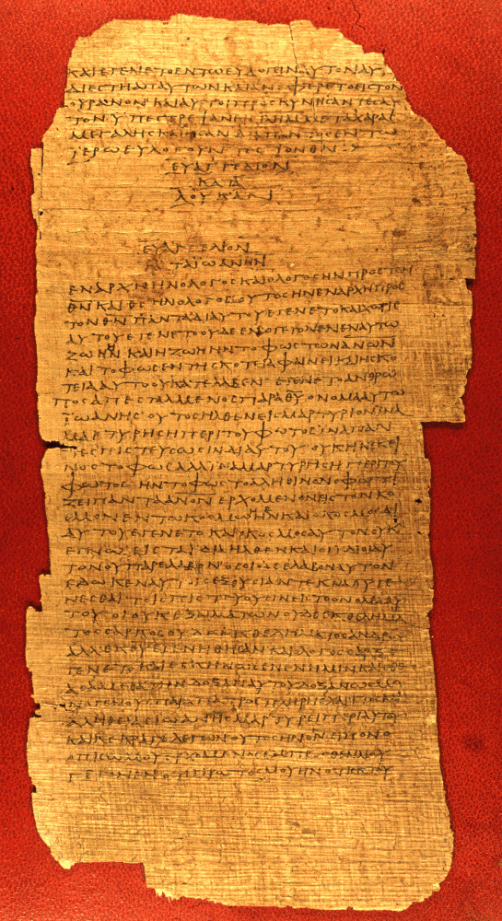
P75 contains Luke 3:18-24:53, and John 1:1-15:8.  The format is called a codex which is the precursor of our modern books.  This picture is the end of Luke and the beginning of John.  102 of 144 pages have survived.  It dates to 100’s AD.  It’s the most significant New Testament papyrus found to date, due to its age and its agreement to later fourth century sources.  It was discovered in the 1950’s.

As Carl also highlighted last week, Luke is writing about “all that Jesus began to do and teach.”   This introductory statement tells us Jesus’ ministry continues in Acts.  Even though we will see Jesus ascend to heaven in the first verses of Acts, He’s still actively involved, driving the story.

Luke stresses the work of the Holy Spirit throughout the book of Acts including His enabling power.  Here we learn that Jesus gave instructions through the Holy Spirit which is in keeping with John 14:26. 

The Helper, the Holy Spirit, whom the Father will send in My name, He will teach you all things and bring to your remembrance all that I have said to you. – John 14:26

We’ll talk more on the Holy Spirit today and in future messages in the series.

After His suffering, He presented Himself to them and gave many convincing proofs that He was alive. He appeared to them over a period of forty days and spoke about the kingdom of God. – Acts 1:3

Jesus’ ultimate suffering was His death on the cross.  However, He rose on the third day, and He came to the disciples many times.  What were Jesus’ convincing proofs that He was alive?  This is a list from a read through of the gospel accounts following the resurrection, Acts 1, and I Corinthians 15.

The stone was rolled away from the tomb Matthew 28:2

The soldiers guarding the tomb were made unconscious (all of them) Matthew 28:4

The testimony of the angel to the Marys, “He is not here; He has risen just as He said.  Come and see the place where He lay.” Matthew 28:5, Luke 24:5-7

Jesus’ body was no longer in the tomb Luke 24:12

The linens that wrapped His body were still wrapped and not strewn about John 20:6-7

Jesus appeared to the disciples multiple times

- to Mary Magdalene at the tomb John 20:14-17

- to the women (Mary Magdalene, Joanna, Mary the mother of James, Salome, and others) while they were on their way to tell the disciples Jesus was risen Matthew 28:9

- to the two disciples on the road to Emmaus (Cleopas and his friend) Luke 24:15-31

- to Peter in Jerusalem Luke 24:34, I Corinthians 15:5

- to the ten and those with them as the two disciples from the Emmaus road were giving their account (behind locked doors, John 20:19) Luke 24:36

- again to the eleven a week later, again behind locked doors John 20:26

- to seven disciples at the Sea of Galilee after Peter went fishing John 21:1-2 (the third time He appeared)

- the eleven saw Him on the mountain in Galilee where Jesus had told them to go Matthew 28:16

- to more than 500 I Corinthians 15:6

- James and all the apostles I Corinthians 15:7

- At the ascension on the Mount of Olives 40 days after the resurrection Luke 24:44-49, Acts 1:6-9

Jesus had them inspect His wounds from the crucifixion Luke 24:39, John 20:20, 26-28

Jesus had them touch Him and confirm He had flesh and bones Luke 24:39

Jesus ate with the disciples Luke 24:42-43, John 21:13-15, Acts 1:4

Jesus opened their minds so they could understand the Scriptures (the prophecies about Him from the Old Testament) Luke 24:45

Jesus breathed on them symbolically bestowing the Holy Spirit John 20:22-23

Jesus performed the miracle to fill the net with fish (153) John 21:6-7

Jesus built a fire and cooked for the disciples John 21:8

Jesus restored Peter after Peter’s betrayal John 21:15-19

Jesus told them to remain at Jerusalem and await the baptism of the Holy Spirit Acts 1:4-5

Jesus gave them the Great Commission after the resurrection Matthew 28:18-20
 

There is a variety of things that Jesus did during those forty days.  In short, Jesus was with the disciples.  He was real to them in those days.  Things were different, especially His appearing and disappearing, but many of the things that Jesus did after the resurrection were things that He did before.  Jesus was convincingly real after the resurrection.

I tried to make this a complete list, but I would not be surprised if you could find more things that Jesus did.  In fact, John admitted that there was plenty more that Jesus did.

Jesus did many other things as well. If every one of them were written down, I suppose that even the whole world would not have room for the books that would be written.  – John 21:25

Acts 1:3 also says that Jesus spoke to the disciples of the kingdom of God.  This too was something Jesus emphasized prior to the resurrection.  50 times in Matthew (eternal life 3 times), 14 times in Mark (eternal life 2 times), 30 times in Luke (eternal life 3 times), 4 times in John (eternal life 14 times).  The kingdom of God is not a small topic.  Depending on the passage, it can refer to the eternal kingship of God; the presence of the kingdom in the person of Jesus Christ, the King; the approaching spiritual form of the kingdom, and the future kingdom.

The kingdom of God, the kingdom of heaven, and eternal life are often used interchangeably.  The story of the rich young ruler includes all three.  If you remember, this young ruler comes to Jesus and asks what he must do to inherit eternal life.  He’s thinking about righteous acts, and he tells Jesus he’s kept the commandments since he was a boy.  Jesus then tells this rich man to sell all he has and to come follow Him.  When the man leaves, Jesus explains that it is hard for the rich to enter the kingdom of God or the kingdom of heaven.  When the disciples ask who then can be saved, Jesus replies, “what is impossible for man is possible for God.”

[Eternal life, entering the kingdom of heaven, being saved … Matthew 19:16, Mark 10:17, Luke 18:18, Matthew 19:23, Mark 10:24, Luke 18:24, Matthew 19:25-26, Mark 10:26-27, Luke 18:26-27]

The parables of Matthew 13:44-45 explain that the kingdom of God is a priceless treasure.  Those who find it are willing to give everything in exchange for it.  Whatever we might have pales in comparison to the kingdom of God. 

On one occasion, while He was eating with them, He gave them this command: "Do not leave Jerusalem, but wait for the gift My Father promised, which you have heard Me speak about. For John baptized with water, but in a few days you will be baptized with the Holy Spirit. – Acts 1:4-5

As we already discussed, this opening of “on one occasion” again shows that this event of being with Jesus after resurrection was something that happened multiple times.  And, it indicates that Jesus ate with the disciples more than once after His resurrection.

I heard a sermon once about resurrection bodies.  It took the example of what Jesus could do in his resurrected body as a basis of what it will be like for us.  We won’t be ethereal spirits.  We will have bodies.  And, we will be able to eat food.  Isn’t that cool?

The gift the Father promised is clearly the Holy Spirit.  Jesus gave a lengthy explanation in John 14, 15 and 16 about the Holy Spirit.  Here, let’s look at just a few verses.  (John 14:26, 15:26-27, 16:12-13)

When the Advocate comes, whom I will send to you from the Father--the Spirit of truth who goes out from the Father--He will testify about Me. And you also must testify, for you have been with Me from the beginning. – John 15:26-27

I have much more to say to you, more than you can now bear. But when He, the Spirit of truth, comes, He will guide you into all the truth. He will not speak on His own; He will speak only what He hears, and He will tell you what is yet to come. – John 16:12-13

Those two passages give us some attributes of the Holy Spirit that we will delve into in Acts 1:8.  The indwelling of the Holy Spirit will cause the disciples to testify, to be witnesses.  The Spirit will also give the disciples guidance beyond what they could grasp while Jesus was with them.

We are told in a few days they will be baptized with the Spirit.  That is nine or ten days in this case.  Luke has just told us that the ascension happens forty days after the resurrection.  Then, the Holy Spirit will come at Pentecost which is 50 days after the Passover.

This is a funny story, but I know a fellow at work who is pretty deep in the word.  He can be so literal about things that it will make you laugh.  I remember years ago that he insisted that the word few meant eight because I Peter 3:20 says that in the ark “only a few people, eight in all, were saved.”  Therefore, a few is eight.  So we can also say based on Acts 1:5 that a few can be nine or ten.

Then they gathered around Him and asked Him, "Lord, are You at this time going to restore the kingdom to Israel?"  He said to them: "It is not for you to know the times or dates the Father has set by His own authority.” – Acts 1:6-7

Jesus’ words about the arrival of the Holy Spirit really got their attention, but probably not in the way He meant.  He told them that the gift of the Holy Spirit was coming, and they all draw near and start asking questions.  You can hear their forks clanging onto their plates as they drop what they’re doing to crowd around.  Their minds went first to an earthly kingdom.  So, why do they keep coming back to an earthly kingdom?

You can look at the situation of the Jewish people at the time of Jesus on several levels.  At 1003 BC, God had promised David to give a King to reign on his throne forever.  And yet, the kings after David were not faithful to follow God. First, the kingdom was divided into north and south, Israel and Judah, and then ultimately, both of those kingdoms were taken over and the people were taken from the land.  Ever since the time of David, the Jewish people were aware of a promised king that had not appeared.

Taking a long but not quite so long range view, since the time the Babylonian captivity began in 605 BC, the Jewish people had almost entirely been subject to Gentile government.  The people were still waiting for the kingdom to be restored.  Babylonian, Persian, Greek (Seleucid, Ptolemaic), and Romans ruled over Israel.  As bad as the corrupt kings of Israel and Judah were, at least they were Jewish.

In somewhat more recent time, there had been a little more than 50 years when the Hasmonean dynasty (Maccabeus family) ruled Judea independently.  Ultimately, the Romans made the Hasmonean leadership a puppet state, followed by the Parthian Empire.  So you have this flash of Jewish leadership that ended up being dissolved completely by 37 BC.  At that time, the Idumean (Edomite) Herods were recognized by Rome and the last Maccabean king was given over to Rome for execution.  At the time of the crucifixion, you have a mix of leadership in Judea both the Roman governor and the Idumean Herods.  Definitely not, the king they envisioned sitting on David’s throne forever and ever.

And so, I don’t think we should be too hard on the disciples for looking to an earthly kingdom.  They likely didn’t know or remember Jesus’ exchange with Pontius Pilate before the crucifixion.

Jesus said,

My kingdom is not of this world. If it were, My servants would fight to prevent My arrest by the Jewish leaders. But now My kingdom is from another place. – John 18:36

But look at how Jesus responds to their question.  He doesn’t tell them that they’re wrong.  A time will come when an earthly kingdom under God’s rule will be restored.  But, it’s not something that anyone but God the Father knows.  The kingdom of God in our time is the body of Christ, all believers.

But you will receive power when the Holy Spirit comes on you; and you will be My witnesses in Jerusalem, and in all Judea and Samaria, and to the ends of the earth. – Acts 1:8

You know I was really interested in what Luke 4:1 says about Jesus and the Holy Spirit.  It says, “Jesus, full of the Holy Spirit, left the Jordan and was led by the Spirit into the wilderness.”  That of course makes you go back to Luke 3.  What happened before that to fill Jesus with the Spirit?

In Luke 3, Jesus is baptized by John the Baptist.  The Spirit descends on Jesus in bodily form, like a dove.  God the Father audibly declared, “You are my Son, whom I love; with You I am well pleased.”  (Luke 3:21-22)

Jesus, the pioneer and forerunner (Hebrews 2:10, 6:20) of our faith, goes before us even in this filling of the Holy Spirit.  Isn’t that fascinating?  We can look to Him in all things!

Luke emphasizes the Holy Spirit, and we will continue to see that throughout the book of Acts (57 times!).  The equipping of the Spirit will enable the Acts of the early church.

Carl gave us his four word synopsis of Acts last week: “Pray and show up.”  Acts 1:8 is the outline of what we will see happening in Acts.  After the arrival of the Holy Spirit in chapter 2, the apostles were first witnesses to Jerusalem up through chapter 7.  Then, the focus moves to Judea and Samaria for chapters 8 till 12.  From chapters 13 onward, the gospel keeps moving outward toward the ends of the earth:  Antioch, Asia Minor, Greece, and Rome.

God’s desire is for the salvation of people in all these places.  Despite the fact that in Jerusalem Jesus was arrested, falsely accused, subject to a sham trial, rejected by an angry mob, and wrongly executed.  Despite the fact that in Judea the people had rejected Jesus’ ministry and teaching.  Despite the fact that Samaria was supposedly filled with impure crossbred pagans.  Despite the fact that the ends of the earth were filled with Gentiles not chosen by God like Israel was.  God’s ways are not like our ways.  God’s thoughts are not like our thoughts.  God wanted witnesses to go to all these people in all these places.

The beginning of this explosive move is the Holy Spirit granting the disciples power.  It is definitely not something they are to take on by themselves, in their own understanding.

It is fascinating that their primary role is as witnesses.  They are not to be kings or rulers or generals or soldiers, but rather witnesses.  They are to testify to what they have seen and heard.  That too is something that takes the emphasis off the disciples and their abilities.  They are to share what they have been impacted by in the previous years, months, and even days.

In fact, it doesn’t even say that they are to become witness or that they need to start acting like witnesses.  It says when the Holy Spirit comes on you, you shall be My witnesses.  An indicative, a change of state rather than an imperative, a call to do a thing.  Remember John 15:27 we talked about earlier where it says the disciples must testify.  They won’t be able to not-testify.

If you have the Spirit, you will be a witness.  If you want to be a witness, you need to be filled with the Holy Spirit.

We look at these things like the Spirit descending bodily on Jesus, and the disciples getting to walk side by side with Jesus, and we can wonder, are we really supposed to get the Spirit like they did?

Luke 11:13 tells us,

If you then, though you are evil, know how to give good gifts to your children, how much more will your Father in heaven give the Holy Spirit to those who ask Him! – Luke 11:13

That’s pretty simple.  If human parents with all their imperfections know how to give good gifts, how much more does God the Father.  What gift is a better gift than the Holy Spirit? 

Berk Wilson gave a great message on the Holy Spirit at Faithwalkers.  One key thought he shared was from I Corinthians 12:13, “For we were all baptized by one Spirit into one body … and we were all given one Spirit to drink.”  We don’t get more of the Spirit, rather the Spirit gets more of you.

Berk also gave a physical example using a glass of milk and chocolate syrup.  First, he took the milk and added the chocolate syrup without stirring.  He explained that a scientific analysis might show a few molecules of chocolate at the top of the glass, but it sure wouldn’t taste very chocolaty if you drank it.

Ephesians 5:18 tells us to “be filled with the Holy Spirit.”  The verb tense there is to keep being filled continually.  It’s like the chocolate milk, it has to keep being stirred or it will settle out.  Couple that command to be filled (Ephesians 5:18) with Luke 11:13 that God will give His Spirit to those who ask and with I John 15:14-15.

This is the confidence we have in approaching God: that if we ask anything according to His will, He hears us.  And if we know that He hears us--whatever we ask--we know that we have what we asked of Him. – 1 John 15:14-15

After He said this, He was taken up before their very eyes, and a cloud hid Him from their sight. They were looking intently up into the sky as he was going, when suddenly two men dressed in white stood beside them. "Men of Galilee," they said, "why do you stand here looking into the sky? This same Jesus, who has been taken from you into heaven, will come back in the same way you have seen Him go into heaven. – Acts 1:9-11

I’ve taught on this passage before, and I remember once comparing it to a visit Melissa made while I was in Germany for a couple of months back in 2004.  The day she flew out was very clear, and I could see the plane fly off till it was the tiniest speck in the sky.  Jesus ascended into a cloud at some point.  The presence of the cloud is consistent with the clouds that surround God’s glory as when He filled the newly constructed temple in Solomon’s day. 

Jesus’ ascension gave the disciples clear understanding that this was a final departure from His first stay on the earth.  He had come and gone several times both appearing and disappearing in the forty days following the resurrection.  By ascending into the cloud, they could understand He was leaving and would not return until He comes back to claim His own.

If that was still not clear, we have the testimony of the two angels who come to tell the disciples what has happened, where Jesus has gone, and how He shall return.

We also come to the title of today’s message.  “Why do you stand here?”   The disciples are encouraged to focus on what they are supposed to be doing rather than wondering where and how Jesus had gone.  In this case, they were instructed to return to Jerusalem and wait. 

Luke 24 tells us this is what they did.  It also tells us how they went.

When [Jesus] had led them out to the vicinity of Bethany, He lifted up His hands and blessed them. While He was blessing them, He left them and was taken up into heaven. Then they worshiped Him and returned to Jerusalem with great joy. And they stayed continually at the temple, praising God. – Luke 24:50-53

They went with great joy.  They weren’t sad.  They were worshiping and praising God.

I love the way the Bible uses these little phrases that have such meaning and power.  Here we have the three simple words, “this same Jesus.”  There would be those who would doubt Jesus was physically on the earth.  That is one belief I’ve heard attributed to Gnosticism.  And yet, with three little words, Acts tells us that this Jesus is one and the same.  The Jesus of the Gospels, of the cross, of the resurrection, of the ascension, who is seated at the right hand of God the Father in heaven.  This same Jesus is coming back for us.  Amen?

This week, I read Psalm 59 in the Amplified.  Yesterday, I realized that the current NIV translates the description of God in Psalm 59 in the same way.  David praises God in that Psalm as “the God I can rely on.”  I thought that was a great description.  We can trust God, rely on Him.  He is the God we can rely on.  What did Jesus say about His return?

Then will appear the sign of the Son of Man in heaven … coming on the clouds of heaven, with power and great glory. – Matthew 24:30

Come Lord Jesus.  Let’s pray.

Jesus, fill our hearts with Your Holy Spirit today, right now.  Give us Your power and glorify Your Name.  We pray for the persecuted believers throughout the earth.  Fill them with Your Spirit and give them Your power, we pray.  Thank you, Jesus.  Amen.

Sunday, January 8, 2023

Introduction to Acts

Good morning! Today, I am excited to begin a new series of messages on the Book of Acts. The Book of Acts is actually a “part two” of a longer work, of which the first part is the Book of Luke. Both are written by Luke, and it is very clear that the books are related by their openings. Here is the opening of Luke:

Many have undertaken to draw up an account of the things that have been fulfilled among us, just as they were handed down to us by those who from the first were eyewitnesses and servants of the word. With this in mind, since I myself have carefully investigated everything from the beginning, I too decided to write an orderly account for you, most excellent Theophilus, so that you may know the certainty of the things you have been taught. – Luke 1:1-4

In my former book, Theophilus, I wrote about all that Jesus began to do and to teach until the day He was taken up to heaven, after giving instructions through the Holy Spirit to the apostles He had chosen. – Acts 1:1-2

Due to practical limitations on the length of a scroll, it makes sense that Luke split his account into two separate documents. We also see that Luke is aware of other accounts of Jesus – so his account is definitely not the first that was written. Interestingly, this tells us that if we can date Luke’s account, then we can know that other gospels accounts were written even earlier.

Now who was Theophilus? We don’t really know. There are multiple theories, but none of them of have convincing evidence. The Ethiopian church (that is, the Coptic church) has a long-held tradition that Theophilus was a Jewish person who at one time lived in Alexandria, Egypt.  Some point out that the “most excellent” prefix to Theophilus in Luke implies that Theophilus was a Roman official. But Luke does not use that prefix again in Acts. Others believe that Theophilus was not a specific person at all, but a rhetorical tool that Luke used to invite people to read the letter. They say this because the name Theophilus means “friend of God,” or “loved by God” – Theo means God and phileo is one of the forms of love, the “friendly” form of love – so anyone who chooses to read Luke’s account is in fact a Theophilus, both a friend of God and loved by God.  

In addition to the question of who Theophilus was is the – I think – more important question of who Luke was. Probably the earliest mention of Luke by someone else is Paul in the book of Philemon, the short letter Paul wrote that concerned the fate of Onesimus, a slave who had fled from his master in Colossae, the location of the Colossian church. At the time this letter was written, Paul was imprisoned in Rome, and in a great God-directed twist of irony, the master that Onesimus fled from was Philemon. The book makes it pretty clear that Onesimus became a believer as a result of interacting with Paul, who writes,

Therefore, although in Christ I could be bold and order you to do what you ought to do, yet I prefer to appeal to you on the basis of love. It is as none other than Paul—an old man and now also a prisoner of Christ Jesus—that I appeal to you for my son Onesimus, who became my son while I was in chains. – Philemon 1:8-10

The phrase “became my son” clearly implies a conversion experience while with Paul. But back to Luke – Philemon ends with the following:

Epaphras, my fellow prisoner in Christ Jesus, sends you greetings. And so do Mark, Aristarchus, Demas and Luke, my fellow workers. The grace of the Lord Jesus Christ be with your spirit. – Philemon 1:23-25

This verse is interesting because it mentions both Luke and Mark. So we see that Luke has direct access to both Paul, so that he can obtain firsthand accounts of what Paul experienced, and also Mark, who is also known as John Mark.

Mark is mentioned in Acts 12:12 as the son of a woman named Mary, whose house was used as a place for early believers to gather and pray, very likely in Jerusalem. Mark is also described as the cousin of Barnabas in Colossians 4:10.

Now, the book of Colossians is an important connection. I think it quite likely that the books of Philemon and Colossians were written at the same time and delivered together, along with Philemon’s slave Onesimus. Colossians is addressed to the entire church in Colossae, whereas Philemon is addressed specifically to Philemon. And so it makes sense that near the end of Colossians we have the following:

Tychicus will tell you all the news about me. He is a dear brother, a faithful minister and fellow servant in the Lord. I am sending him to you for the express purpose that you may know about our circumstances and that he may encourage your hearts. He is coming with Onesimus, our faithful and dear brother, who is one of you. They will tell you everything that is happening here. – Colossians 4:7-9

Colossians goes on:

My fellow prisoner Aristarchus sends you his greetings, as does Mark, the cousin of Barnabas. (You have received instructions about him; if he comes to you, welcome him.) Jesus, who is called Justus, also sends greetings. These are the only Jews among my co-workers for the kingdom of God, and they have proved a comfort to me. Epaphras, who is one of you and a servant of Christ Jesus, sends greetings. He is always wrestling in prayer for you, that you may stand firm in all the will of God, mature and fully assured. I vouch for him that he is working hard for you and for those at Laodicea and Hierapolis. Our dear friend Luke, the doctor, and Demas send greetings. – Colossians 4:10-14  

And so – maybe you thought this was a “rabbit trail” – but see? It all comes back to Luke. Paul’s wording here tells us some important things about Luke. He is “our” dear friend, which means he was well known and loved among the Colossians, and we also learn his occupation: Luke was Dr. Luke, a medical doctor. What did medical doctors do at the time of Paul, the time of the Romans? They, like the Greek doctors before them, relied heavily on herbal remedies, with some animal remedies. They did not yet understand the association of germs with disease. But at least some of the herbal remedies were reasonably effective at treating certain conditions. It is easy for us to forget that many remedies we use today may be made in the lab but were originally derived from plants.

Roman-era doctors did surgery when there were no other options. They carried tool kits that included arrow extractors, scalpels, catheters, and forceps. They used boiling water to sterilize their tools before using them. They could certainly do things like re-setting and splinting broken bones or immobilizing sprains. Although they had some herbal and other antibiotic treatments, because they didn’t really understand the germ nature of infection, and because stronger antibiotics were unknown, bacterial infections were often fatal.

Doctors were usually Greek in background, and ironically, looked down on somewhat by typical Romans, simply because they didn’t like the Greeks. But they definitely depended on Greeks for engineering, medical practices, and other technical needs. Yet doctors and other technical professionals were extremely highly educated, and based on the literary quality of Luke’s writing, we know that Luke was highly educated as well.

Like today, if not even more so, before doctors took any action, they would do a detailed examination of the patient, asking questions of symptoms and palpitating and looking at affected and non-affected areas of the body. Attention to detail was critical. And because Luke was trained in this way, he was indeed an ideal person to “carefully investigate everything from the beginning” and write “an orderly account” of both the events of Jesus (the Book of Luke) and the development of the early church (the Book of Acts).

Here is what the famous secular archaeologist Sir William M. Ramsay had to say about the Book of Acts after a lifetime of exploring locations described carefully by Luke:

The present writer takes the view that Luke's history is unsurpassed in respect of its trustworthiness...You may press the words of Luke in a degree beyond any other historian's, and they will stand the keenest scrutiny and the hardest treatment, provided always that the critic knows the subject and does not go beyond the limits of science and of justice...Acts may be quoted as a trustworthy historical authority....Luke is a historian of the first rank; not merely are his statements of fact trustworthy; he is possessed of the true historic sense; he fixes his mind on the idea and plan that rules in the evolution of history; and proportions the scale of his treatment to the importance of each incident. He seizes the important and critical events and shows their true nature at great length, while he touches lightly or omits entirely much that was valueless for his purposes. In short, this author should be placed along with the very greatest of historians.

In addition to the evidence in Philemon and Colossians of Luke’s association with Paul, we also have Luke’s use of the first person “we” in later parts of the Book of Acts.

During the night Paul had a vision of a man of Macedonia standing and begging him, “Come over to Macedonia and help us.” After Paul had seen the vision, we got ready at once to leave for Macedonia, concluding that God had called us to preach the gospel to them. – Acts 16:9-10

Luke was there in Acts 16 in Philippi when Lydia, “a dealer in purple cloth” became a believer, and he was also there when a demon was cast out of a slave who relied on the spirit to tell the future. The whole city went up in arms, and Paul and Silas (but not Luke) was arrested, beaten, and put into prison. An earthquake broke the jail open, and the jailor and his family came to faith.

It appears that Luke did not join Paul beyond Philippi in this journey, but when the third missionary journey came to Philippi and went from there, Luke was with them once again.

When the uproar had ended, Paul sent for the disciples and, after encouraging them, said goodbye and set out for Macedonia. He traveled through that area, speaking many words of encouragement to the people, and finally arrived in Greece, where he stayed three months. Because some Jews had plotted against him just as he was about to sail for Syria, he decided to go back through Macedonia. He was accompanied by Sopater son of Pyrrhus from Berea, Aristarchus and Secundus from Thessalonica, Gaius from Derbe, Timothy also, and Tychicus and Trophimus from the province of Asia. These men went on ahead and waited for us at Troas. But we sailed from Philippi after the Festival of Unleavened Bread, and five days later joined the others at Troas, where we stayed seven days. – Acts 20:1-6  

And so Dr. Luke was there when Eutychus, falling asleep during a long sermon of Paul, fell from the window and died, but Luke’s services were not needed because Paul, through the power of God, basically hugged him back to life and to health. He was there when Paul met briefly with the elders of Ephesus on the way to Jerusalem. Luke was with Paul as he made it to Jerusalem, and after Paul’s arrest, he was with him as he made his way as a prisoner to Rome.

And Paul, writing to Timothy in 2 Timothy, says this near the end of the letter:

Do your best to come to me quickly, for Demas, because he loved this world, has deserted me and has gone to Thessalonica. Crescens has gone to Galatia, and Titus to Dalmatia. Only Luke is with me. Get Mark and bring him with you, because he is helpful to me in my ministry. I sent Tychicus to Ephesus. When you come, bring the cloak that I left with Carpus at Troas, and my scrolls, especially the parchments. – 2 Timothy 4:9-13

And so we see that Luke was with Paul extensively, and was therefore the perfect person to write the Book of Acts.

When was Acts written? I agree with many conservative scholars that it was likely written in the 60s AD, before the fall of Jerusalem in 70 AD, because neither Luke nor Acts records this extremely momentous event. Also, Acts does not record the death of James (likely 62 AD) or of Paul (likely the late 60s AD). The book also devotes much ground to the question of whether there can be Gentile believers in Christ, and what practices they must follow, a topic that was seen as settled and not really important anymore by the time that the number of Gentile believers explodes, which occurred by the 80s AD. This is important from a reliability point of view, because it means that there was absolutely no time for historical “revision”, mythmaking, and so on. We have every reason to trust Acts, even apart from reasons of faith, as accurate.

And so what is Acts about? We have already hinted a lot at this, and I know that most, if not all of you, are quite familiar with Acts. But the overall structure is interesting, and it is easy to miss the forest for the trees as we go deeply into the book line by line in later weeks. So let us look at the overall structure. Looking again at the opening of Acts:

In my former book, Theophilus, I wrote about all that Jesus began to do and to teach until the day He was taken up to heaven, after giving instructions through the Holy Spirit to the apostles He had chosen. – Acts 1:1-2

Notice the word “began”. The book of Luke is about what Jesus “began to do” so the book of Acts is about what Jesus continued to do, after His death and resurrection. People often call the book the Book of the Acts of the Apostles, but an equally valid name would be the Book of the Continued Acts of the Triune God. I have frequently joked that my one line summary of the Book of Acts is “Pray and show up” because God orchestrates the rest. I think it is a pretty good rule for life: Pray and show up.

After an introduction in Acts 1, which summarizes the risen Jesus telling the disciples that the Holy Spirit will come and empower them to be His witnesses. Jesus then rises up in a cloud, with the angelic messenger telling the disciples to move on, but also that Jesus will one day return the same way.

In Acts 1:8, Jesus tells His disciples that:

“You will be My witnesses in Jerusalem, and in all Judea and Samaria, and to the ends of the earth.” – Acts 1:8b

And this verse is pretty good summary of the Book of Acts. Chapters 2-7 take place in Jerusalem, Chapters 8-12 take place in Judea and Samaria, and the remaining chapters begin the process of going to the ends of the earth, a process that is continuing to this day.

There is an interesting comparison/contrast study you can make between Luke and Acts. The following observations are due to Prof. John Stevenson. In terms of commonalities: Both begin, following their openings to Theophilus, with angelic announcements. Both begin in Jerusalem. Luke then deals with the birth of Jesus as the Spirit comes on Mary. Acts then deals with the birth of the church as the Holy Spirit comes on Christian believers.

In terms of contrasts: Luke emphasizes a movement toward Jerusalem, whereas Acts emphasizes a movement away from Jerusalem – note that Luke ends with the disciples in Jerusalem; Acts ends with Paul far away, in Rome. Both emphasize Christ with His people, but in Luke the presence is physical, whereas in Acts it is spiritual; in Luke it is external, but in Acts, it is internal.   

In the process of this development, we see the disciples, empowered by the Holy Spirit, performing miracles like the miracles Jesus performed. We see believers not only among the Jews, but now also among the nations. We see the fulfillment of countless prophecies in the Old Testament that show God redeeming not only members of the people of Israel, but people from every nation and every tongue and every tribe and every nation. A few examples:

“..and through your [Abraham’s] offspring all nations on earth will be blessed, because you have obeyed Me.” – Genesis 22:18

“Your [Jacob’s] descendants will be like the dust of the earth, and you will spread out to the west and to the east, to the north and to the south. All peoples on earth will be blessed through you and your offspring.” – Genesis 28:14

“All the ends of the earth will remember and turn to the Lord, and all the families of the nations will bow down before Him,..” – Psalm 22:27

“May His name endure forever; may it continue as long as the sun. All nations will be blessed through Him, and they will call Him blessed.” – Psalm 72:17

“Turn to Me and be saved, all you ends of the earth; for I am God, and there is no other.” – Isaiah 45:22

“[The Lord] says: ‘It is too small a thing for You to be My servant to restore the tribes of Jacob and bring back those of Israel I have kept. I will also make You a light for the Gentiles, that You may bring My salvation to the ends of the earth.'” – Isaiah 49:6

“The Lord will lay bare His holy arm in the sight of all the nations, and all the ends of the earth will see the salvation of our God.” – Is. 52:10

“He was given authority, glory and sovereign power; all peoples, nations and men of every language worshipped Him. His dominion is an everlasting dominion that will not pass away, and His kingdom is one that will never be destroyed.” – Daniel 7:14

“The Lord will be awesome to them when He destroys all the gods of the land. The nations on every shore will worship Him, every one in its own land.” – Zephaniah 2:11

And so the Book of Acts shows us how the salvation of God spread from believing Jews to believing non-Jews. It’s a beautiful account – with actions led by God, and frankly the response of the Jewish believers, including Peter, was something like, “Oh. Well, that’s definitely happening. It would be unthinkable for us to stand in the way of that, not that we could.”

But one more thing we see in Acts is persecution. The persecution of God’s people is also something we see repeatedly prophesied, especially and specifically by Jesus. A few examples:

“If the world hates you, keep in mind that it hated Me first. If you belonged to the world, it would love you as its own. As it is, you do not belong to the world, but I have chosen you out of the world. That is why the world hates you. Remember what I told you: ‘A servant is not greater than his master.’ If they persecuted Me, they will persecute you also. If they obeyed My teaching, they [would] obey yours also. They will treat you this way because of My name, for they do not know the One who sent Me. If I had not come and spoken to them, they would not be guilty of sin; but now they have no excuse for their sin. Whoever hates Me hates My Father as well. If I had not done among them the works no one else did, they would not be guilty of sin. As it is, they have seen, and yet they have hated both Me and My Father. But this is to fulfill what is written in their Law: ‘They hated Me without reason.’” – John 15:18-25

“They will put you out of the synagogue; in fact, the time is coming when anyone who kills you will think they are offering a service to God. They will do such things because they have not known the Father or Me. I have told you this, so that when their time comes you will remember that I warned you about them.” – John 16:2-4a

“I have told you these things, so that in Me you may have peace. In this world you will have trouble. But take heart! I have overcome the world.” – John 16:33

Acts shows us this persecution, but we see how God uses the persecution to scatter God’s followers and even more rapidly multiply the gospel. God also uses persecution to refine the faith of those who profess to follow Him.

Regarding persecution, I want to read a pair of ancient letters from the “other side.” The first letter is by Pliny the Younger, written about 110 AD, about 40 years after Acts was written, basically one generation after the final events in Acts. At this point, it is no longer the Jews who are the source of persecution – it is the Romans, who are acting in more and more aggressive ways because the Christians have multiplied so greatly that it is beginning to affect the very culture – people are leaving the old gods, no longer attending the temples, and no longer considering the emperor to be God. This fear of a people who are multiplying like crazy should remind you of something from the Old Testament – it should remind you of Egypt in the time between Joseph and Moses.

A relatively inexperienced Pliny the Younger was made governor of Bithynia, a small, mostly backwater region in what is now Turkey. (It does contain one important city, though.) As questions arose about governing, he would write to Emperor Trajan. The letter is important because it clearly establishes the growing Christian church in a source outside the Book of Acts.

Bithynia is mentioned twice in Scripture: once in Acts 16:7, as a place Paul desired to visit on one of his missionary journeys, but a place that it says the Spirit of Jesus did not allow them to go to. And once in the opening of I Peter, as one of the locations of believers that this letter was addressed to. So we know that there were believers multiplying in this location even in New Testament times.

I will say that reading these letters reminds me of reading the Screwtape Letters, by C.S. Lewis. In many ways, it is like a real-life Screwtape, who if you have not read the book, is written from the perspective of a young demon seeking advice from an older demon on how to best keep those under his charge away from Christianity, or failing this, making them unproductive. If you have never read it, you should definitely do so, as its “backwards” presentation is used to powerfully remind us to do the opposite of what the demons in the story try to get the people to do. In any case, here is Pliny’s letter:

It is my practice, my lord, to refer to you all matters concerning which I am in doubt. For who can better give guidance to my hesitation or inform my ignorance? I have never participated in trials of Christians. I therefore do not know what offenses it is the practice to punish or investigate, and to what extent. And I have been not a little hesitant as to whether there should be any distinction on account of age or no difference between the very young and the more mature; whether pardon is to be granted for repentance, or, if a man has once been a Christian, it does him no good to have ceased to be one; whether the name itself, even without offenses, or only the offenses associated with the name are to be punished.

Meanwhile, in the case of those who were denounced to me as Christians, I have observed the following procedure: I interrogated these as to whether they were Christians; those who confessed I interrogated a second and a third time, threatening them with punishment; those who persisted I ordered executed. For I had no doubt that, whatever the nature of their creed, stubbornness and inflexible obstinacy surely deserve to be punished. There were others possessed of the same folly; but because they were Roman citizens, I signed an order for them to be transferred to Rome.

(Note here the consistency of what we find in the Book of Acts in how Paul, a Roman citizen, is transferred to Rome after he is arrested.)

Soon accusations spread, as usually happens, because of the proceedings going on, and several incidents occurred. An anonymous document was published containing the names of many persons. Those who denied that they were or had been Christians, when they invoked the gods in words dictated by me, offered prayer with incense and wine to your image, which I had ordered to be brought for this purpose together with statues of the gods, and moreover cursed Christ—none of which those who are really Christians, it is said, can be forced to do—these I thought should be discharged. Others named by the informer declared that they were Christians, but then denied it, asserting that they had been but had ceased to be, some three years before, others many years, some as much as twenty-five years. They all worshipped your image and the statues of the gods, and cursed Christ.

(To be clear here – what the arrested had to do was simply light a candle, splatter some wax and some wine in the direction of a statue of the emperor and of one of their gods, and curse Christ out loud. To do this would only take a few seconds. Do this, and you would be released. Fail to do so, and you faced death, and probably an extremely painful and public death.)

They asserted, however, that the sum and substance of their fault or error had been that they were accustomed to meet on a fixed day before dawn and sing responsively a hymn to Christ as to a god, and to bind themselves by oath, not to some crime, but not to commit fraud, theft, or adultery, not falsify their trust, nor to refuse to return a trust when called upon to do so. When this was over, it was their custom to depart and to assemble again to partake of food—but ordinary and innocent food. Even this, they affirmed, they had ceased to do after my edict by which, in accordance with your instructions, I had forbidden political associations.

(These are the ones who would not deny their faith. They asked Pliny if what they were doing, simply gathering together, singing a hymn to Christ, and prior to the ban, remembering the Lord with the bread and the cup – whether that was really so terrible. They pointed out that they committed no crime but indeed committed to be absolutely upright.)

Accordingly, I judged it all the more necessary to find out what the truth was by torturing two female slaves who were called deaconesses. But I discovered nothing else but depraved, excessive superstition.

(Notice here the external validation of the fact that the early believers elevated both slaves and women to positions of responsibility, a radically progressive step for that time.)

I therefore postponed the investigation and hastened to consult you. For the matter seemed to me to warrant consulting you, especially because of the number involved. For many persons of every age, every rank, and also of both sexes are and will be endangered. For the contagion of this superstition has spread not only to the cities but also to the villages and farms. But it seems possible to check and cure it. It is certainly quite clear that the temples, which had been almost deserted, have begun to be frequented, that the established religious rites, long neglected, are being resumed, and that from everywhere sacrificial animals are coming, for which until now very few purchasers could be found. Hence it is easy to imagine what a multitude of people can be reformed if an opportunity for repentance is afforded. (Epistulae X.96)

It is a fascinating and also a terrible account. The gospel has spread so far and wide that Pliny is maybe wondering if the entire region has “fallen for this superstition.” Let’s look at the second letter, Trajan’s response. If you recall, we spoke multiple times in recent weeks about Trajan and his propensity for putting up idols at the locations of destroyed Jewish and Christian worship sites. Ironically, his doing so helped preserve these locations for posterity. Here is what Trajan wrote:

You observed proper procedure, my dear Pliny, in sifting the cases of those who had been denounced to you as Christians. For it is not possible to lay down any general rule to serve as a kind of fixed standard. They are not to be sought out; if they are denounced and proved guilty, they are to be punished, with this reservation, that whoever denies that he is a Christian and really proves it—that is, by worshiping our gods—even though he was under suspicion in the past, shall obtain pardon through repentance. But anonymously posted accusations ought to have no place in any prosecution. For this is both a dangerous kind of precedent and out of keeping with the spirit of our age. (Epistulae X.97)

As time went on, to the time of Diocletian, the persecution became even worse. But despite all this, Christians continued to multiply. It is humbling to understand what those before us had to go through so that we could have faith today. And throughout the world, there are still those who face severe persecution, and the Bible tells us that a time is coming when it will become worse again.

Did Bithynia survive this persecution? Well, Bithynia contains Nicaea, the birthplace of the Nicaean Creed, composed in 325 AD. My prayer for us, as we go through the Book of Acts this year, is that doing so would deepen our faith and commitment to God, and that it would deepen our commitment to seeking out people who would be receptive to the gospel and helping to continue to grow the kingdom of God.